

For the 2026 Paris Olympics, a single multi-country eSIM is the smartest way to manage your mobile data, offering seamless connectivity not just in Paris but across any European side trips, eliminating the need for multiple physical SIM cards or expensive roaming charges.
Paris 2026: Your Ticket to Europe, Not Just the Games
The Summer Olympics in Paris are going to be spectacular, no doubt. But for a seasoned traveler like me, someone who's spent years navigating everything from the bustling markets of Djemaa el-Fna to the serene temples tucked away in Kyoto's Arashiyama, an event like this is always an excuse to see more than just the main attraction. You've booked your tickets for the diving at the Paris La Défense Arena, maybe the athletics at Stade de France, but what about the winding canals of Amsterdam, the art galleries in Berlin's Mitte district, or a culinary detour through Bologna's Quadrilatero?
This isn't just about watching the world's best athletes, it's about soaking in the continent. And in 2026, the key to making those spontaneous side trips, those last-minute train bookings, and those urgent WhatsApp calls with your travel companions, is rock-solid, affordable data. Forget the days of hunting down a Telekom Deutschland shop in Frankfurt or an Orange boutique in Nice just for a local SIM. We're well past that.
The European Adventure Beyond the Olympic Village
Imagine this: you've just seen a thrilling handball match at the Porte de Versailles Exhibition Centre. The energy is electric. But instead of fighting the crowds for dinner in the 15th arrondissement, you decide to catch the evening TGV from Gare de Lyon to Geneva for a quick hike in the Alps. Or perhaps, after the closing ceremonies, you're off to Rome, planning to arrive at Termini Station and head straight to Trastevere for some authentic Cacio e Pepe. How do you keep your maps, your translation apps, and your group chats alive every step of the way without breaking the bank?
It boils down to smart planning, and in 2026, that means embracing the multi-country eSIM. It's the kind of tool that would have saved me countless headaches (and euros) back in my early days of globetrotting. It's not just about convenience; it's about freedom.
Why a Multi-Country eSIM is Your Best Travel Companion
I remember a trip to Italy, oh, must have been 2018. Landed in Milan, needed data immediately to call my Airbnb host in the Brera district. My phone, an older model iPhone, didn't support eSIMs yet. I spent a good hour at Malpensa Airport trying to find a Vodafone or TIM shop that was open past 8 PM, only to discover their prepaid SIM options were convoluted and required a stack of paperwork. That's an hour of prime travel time I'll never get back. An hour where I could have been enjoying an aperitivo.
This is where a multi-country eSIM changes the game. It's a digital SIM profile, stored right on your phone, ready to activate with a QR code or a few taps. No physical swapping, no frantic searches for local shops with inconvenient hours, no language barriers. For a multi-leg European trip, it’s simply indispensable. It means your data plan seamlessly follows you from the boulevards of Paris to the canals of Venice to the techno clubs of Berlin, all without changing a thing.
Seamless Transitions Across Borders
Think about crossing borders in Europe. One minute you're on the Thalys train pulling into Brussels-Midi, the next you're exploring the Grand-Place. With a multi-country eSIM, your phone simply connects to a local partner network (like Proximus in Belgium, or KPN in the Netherlands), and your data continues flowing. No dropped calls, no lost navigation, no sudden bill shocks. It's designed for exactly this kind of fluid travel that Europe excels at.
This seamless connectivity is particularly crucial for events like the Olympics. You'll be moving between venues, perhaps dashing from the Parc des Princes in the 16th to Centre Aquatique in Saint-Denis, and relying on real-time updates for schedules, transit, and meeting up with friends. A hiccup in data can mean a missed event or a frustrating delay.

Navigating Paris and Beyond with eSIM-Powered Apps
Data isn't just for social media updates; it's your lifeline. In Paris, you'll be using apps like Citymapper or Bonjour RATP to navigate the Métro, RER, and bus lines run by RATP. You'll need Google Maps to find that hidden crêperie in Le Marais or to plot a route from your hotel in Saint-Germain-des-Prés to the Olympic venues. Out of Paris, if you decide to take a high-speed ICE train to Berlin, you'll be using the Deutsche Bahn app to check schedules and platform changes at Berlin Hauptbahnhof.
Having reliable data from the moment you land at Charles de Gaulle Airport (CDG) is non-negotiable. I can't tell you how many times I've arrived somewhere, bleary-eyed, only to find the airport Wi-Fi spotty or requiring a registration process that wouldn't load. The panic of not being able to summon an Uber or find my way to a specific metro line is a travel memory I'd rather not repeat. A pre-activated eSIM means you're connected the second your plane touches down.
Essential Apps That Thrive on Uninterrupted Data
- Transit Apps: Beyond Paris's RATP apps, you might use BVG Fahrinfo for Berlin's U-Bahn and S-Bahn, or Transport for London (TfL) Go for a quick hop over to London via the Eurostar. These are data hogs, updating in real-time.
- Mapping & Navigation: Google Maps, Apple Maps, or even Waze, are crucial for walking directions, finding local spots, and understanding public transport routes.
- Communication: WhatsApp, Telegram, or Facetime are how you'll keep in touch with family back home and fellow travelers. Don't underestimate the comfort of a quick video call.
- Translation Apps: Google Translate or DeepL can be invaluable when ordering a coffee in a small café in Rome or deciphering a menu in a tiny German village.
- Ticketing & Bookings: Whether it's booking a museum entry, a train ticket, or a last-minute dinner reservation through La Fourchette, constant data is key.
Without reliable data, these apps are just icons on your screen. With a multi-country eSIM, they become powerful tools that truly enhance your travel experience. You can even use your phone as a hotspot in a pinch, though be mindful of your data allowance!
Avoiding the Dreaded Bill Shock: My €280 Story
Let's talk about roaming. Oh, roaming. My personal horror story dates back to a trip a few years ago. I was in the UK, just for a layover, and completely forgot to turn off my data roaming after my previous stop in Morocco. I needed to quickly check a flight detail on the British Airways app while waiting for my connection at Heathrow. Ten minutes later, I had a text from my home carrier warning me of excessive data usage. A few weeks after returning home, the bill arrived: a staggering €280 for a mere 15 minutes of data. It was a painful lesson in forgetting to avoid bill shock with an eSIM.
This is precisely the kind of financial pain a multi-country eSIM is designed to prevent. Instead of relying on your home carrier's expensive international roaming rates, which can easily climb to €10-€15 per MB in some regions, an eSIM provides local rates or competitive bundles across multiple countries. The transparency alone is worth its weight in gold. You know exactly what you're paying for, upfront.
The Cost of Connectivity: Traditional vs. eSIM
| Method | Pros | Cons | Typical Cost (10GB, 30 days) |
|---|---|---|---|
| Home Carrier Roaming | Convenient, uses existing number | Extremely expensive, hidden fees, limited data | €150 - €500+ (if even offered) |
| Local Physical SIM | Local rates, often good coverage | Time-consuming to buy/activate, loss of home number, physical swapping | €20 - €40 per country |
| Multi-Country eSIM | Seamless across borders, instant activation, retains home number, competitive rates | Requires eSIM-compatible phone, initial setup can be unfamiliar | €25 - €60 (for Europe-wide plan) |
That €280 incident taught me to always prioritize prepaid, transparent data solutions. With a multi-country eSIM, I've used it from Portugal to Poland, always knowing my data allowance and usage. It means I can focus on finding that perfect little pastry shop in Paris's Latin Quarter instead of worrying about my data meter ticking up.
Choosing the Right eSIM Plan for Your European Adventure
With so many options out there, how do you pick the right eSIM plan for your Olympic journey and European explorations? It really comes down to your travel style: how many countries you'll visit, how long you'll be gone, and how much data you anticipate using. Will you be streaming every event live on the go, or just using maps and messaging?
For a trip centered around the Paris Olympics, lasting perhaps two weeks with a few side excursions to nearby countries like Belgium, Germany, or Italy, a regional Europe-wide plan is almost certainly your best bet. These plans typically cover 30-40+ countries within Europe, ensuring you're covered whether you're taking a scenic train through the Swiss Alps or exploring the ancient ruins of Rome.
Data Allowance: How Much Do You Really Need?
Consider your data habits. Are you a heavy user, constantly uploading photos and videos, or a light user who just needs connectivity for navigation and communication? For a typical two-week trip with some Olympic event streaming and general browsing, I'd recommend at least 10GB. If you're traveling with family or plan to use your phone as a hotspot, definitely bump that up to 20GB or more.
Remember, it's always better to slightly overestimate than run out of data midway through your trip. To give you a better idea, a 15GB plan is usually sufficient for a month of moderate use, including some video streaming and heavy map usage. For more detailed insights, you might find The Savvy Traveler's Guide to Multi-Country eSIM Plans helpful.
| Data Plan | Typical Usage | Recommended For |
|---|---|---|
| 5 GB, 15 Days | Light browsing, maps, messaging | Short city breaks, minimal data users |
| 10 GB, 30 Days | Moderate browsing, social media, some video | Average Olympic visitor, few side trips |
| 20 GB, 30 Days | Heavy browsing, streaming, video calls, hotspot | Longer trips, digital nomads, families, heavy data users |
| Unlimited Data (Fair Use) | Very heavy streaming, constant hotspot, remote work | Business travelers, remote workers, those who cannot risk running out of data |
Setting Up Your eSIM Before You Land
One of the biggest advantages of an eSIM is the ability to purchase and activate it before you even leave home. This means you're connected the moment your plane touches down at Paris-CDG or Orly. No waiting, no airport queues, no fuss.
My personal ritual involves buying my eSIM plan a few days before departure. This gives me ample time to install it, test it (if I'm feeling extra cautious), and ensure everything is ready to go. You don't want to be fumbling with settings on a red-eye flight, believe me.
A Step-by-Step Guide to eSIM Activation
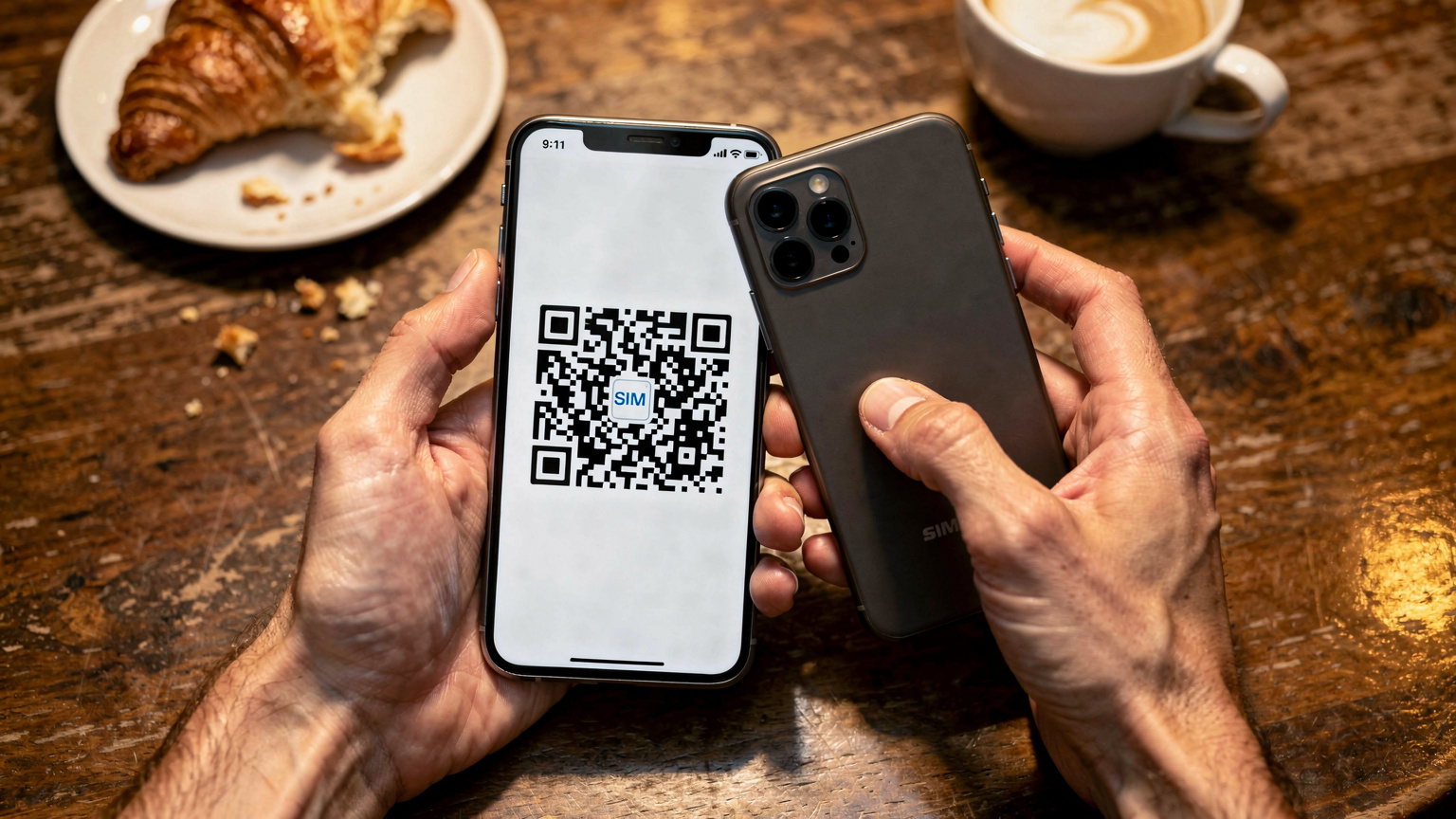
The process is surprisingly straightforward, even for those who aren't tech-savvy. Most eSIM providers will send you a QR code via email immediately after purchase. Here’s how it generally works for an iPhone (for Android, the steps are very similar, just slightly different menu names):
- Purchase Your eSIM Plan: Head to the website and select your desired European multi-country plan. Complete the purchase.
- Receive Your QR Code: You'll typically get an email with a QR code and manual installation details. Save this email or print the QR code.
- Install the eSIM (Pre-Departure):
- On your iPhone, go to Settings > Cellular (or Mobile Data) > Add eSIM.
- Choose Use QR Code and scan the code you received.
- Follow the prompts to label your new eSIM (e.g., "Europe Travel").
- When prompted, choose to keep your primary line for calls and texts, and select your new eSIM for mobile data.
- Crucially, for now, keep the new eSIM line turned OFF until you land in Europe to avoid premature data usage or conflicts with your home plan.
- Activate Upon Arrival:
- Once your plane lands in Paris, go back to Settings > Cellular (or Mobile Data).
- Toggle your new "Europe Travel" eSIM line to ON.
- Ensure Data Roaming is enabled for the new eSIM line (this is usually necessary for multi-country plans, but it's not the same as your home carrier's expensive roaming).
- Turn OFF your primary home SIM's mobile data to avoid any accidental charges.
If you encounter any issues, remember to check out resources like T-Mobile eSIM QR Code Not Working? Quick Fixes for Savvy Travelers. Sometimes, a simple restart of your phone can work wonders.
Troubleshooting Common eSIM Hiccups
Even with the best preparation, sometimes things don't go perfectly. I've been there, staring at my phone, seeing 'No Service' when I expected glorious 5G. It happens. The good news is that most eSIM issues are easily resolved with a few simple steps. The key is not to panic, especially when you're trying to figure out which direction the RER B goes from Châtelet–Les Halles.
Quick Fixes for Connectivity Issues
- Restart Your Device: The classic tech solution. A simple reboot often resolves minor network glitches.
- Check APN Settings: Sometimes, the Access Point Name (APN) settings aren't automatically configured. Most eSIM providers will give you the correct APN to manually enter in your phone's cellular settings.
- Ensure Data Roaming is ON for eSIM: While you turn off data roaming for your home SIM, your multi-country eSIM usually requires its own data roaming to be enabled to connect to partner networks across different countries. Double-check this setting for your eSIM profile.
- Select Network Manually: If your phone isn't automatically connecting, try going to your cellular settings, turning off 'Automatic Network Selection,' and manually choosing one of the listed partner networks in your current country.
- Contact Support: If all else fails, reach out to your eSIM provider's customer support. They're usually quick to respond and can often troubleshoot remotely.
I once had an issue in Budapest where my eSIM wouldn't connect, and it turned out I just needed to manually select the 'Vodafone HU' network. It felt like a small victory, knowing I didn't have to seek out a local kiosk in Ferenciek tere. For more detailed instructions, especially for iPhones, Activating Your Data in Seconds is a valuable guide.

eSIM for the Family: Data Freedom for Everyone
Traveling with family, especially to a major event like the Olympics, adds another layer of complexity to connectivity. Keeping everyone connected, whether it's for coordinating meeting points at the Olympic Village or letting teenagers stream their favorite shows on a long train ride from Paris to Bruges, can be a challenge. This is where the flexibility of eSIMs truly shines.
My sister once took her family to the Singapore F1 Grand Prix, and she told me the biggest stressor wasn't the heat, but keeping her kids' phones topped up with data. They ended up buying separate physical SIMs for each device, which quickly became a management nightmare. That's a hassle you simply don't need when you're trying to enjoy the Games.
Sharing Data and Staying Together
If you have multiple eSIM-compatible devices, each family member can have their own eSIM plan, tailored to their usage. This ensures everyone has their own reliable data connection. For families with only one eSIM-compatible phone, or if you prefer to manage data centrally, you can activate an eSIM on a primary device and use its hotspot feature to share data with other family members.
This method is excellent for keeping track of data usage and controlling costs. Just remember that using a hotspot can drain your phone's battery faster, so a portable power bank is a wise investment. Imagine the peace of mind knowing your kids can always reach you, or look up directions, even if they wander off to get a souvenir from a vendor near the Eiffel Tower.
| Family Data Strategy | Pros | Cons | Best For |
|---|---|---|---|
| Individual eSIMs | Each person has dedicated data, maximum independence | Higher cost, more eSIMs to manage | Families with multiple eSIM-compatible phones, older children/teens |
| Primary Phone Hotspot | Cost-effective, central data management, one eSIM to buy | Primary phone battery drain, hotspot range limitation | Families with younger children, limited eSIM-compatible devices |
| Mix-and-Match | Flexibility to suit different needs | Can be slightly more complex to manage | Families with varied data needs and device compatibility |
Post-Olympics Explorations: Keeping Your Data Flowing
The Olympics are a fantastic reason to visit Paris, but Europe offers so much more. After the medals have been awarded and the Olympic flame extinguished, your multi-country eSIM will still be your trusted companion as you venture further afield. Whether you're planning a week in the Côte d'Azur, a cultural deep-dive in Florence, or even a return trip to London for some theatre, your data needs won't change.
I've always believed that the best trips are those that evolve. I once planned a two-week trip to Spain, which spontaneously extended to a month, taking me from Barcelona to Lisbon. Having a flexible data plan allowed me to book last-minute flights, find hostels in unexpected towns like Sintra, and stay connected with family without a hitch. The beauty of a multi-country eSIM is that it supports this kind of spontaneous, unscripted travel.
Extending Your Stay or Your Data
Many eSIM providers offer the flexibility to top up your data or extend your plan duration directly from their app or website. This means if your two-week trip suddenly turns into three, you don't need to scramble for a new SIM. You can just add more data to your existing eSIM profile, often within minutes. This is a far cry from the old days of buying a new physical SIM, going through the registration process again, and potentially losing your original number.
This convenience is especially valuable when you're deep into exploring a new city. Say you're enjoying the street art in Berlin's Kreuzberg district and decide you need another week. A few taps on your phone, and your data is extended. No disruption to your adventures, no wasted time searching for a phone shop that might close at 6 PM on a Saturday. This is the kind of freedom that truly makes a European eSIM a travel essential.
Final Thoughts on Seamless European Travel
The 2026 Paris Olympics will be an unforgettable experience, a true celebration of sport and culture. But for the savvy traveler, it's also an opportunity to explore the broader tapestry of Europe. From the moment you land at CDG, to cheering on your favorite athletes, to taking that scenic train ride to Munich, your mobile data will be the silent backbone of your journey.
Embracing a multi-country eSIM isn't just about avoiding high roaming costs, though that's a huge benefit. It's about empowering your travel experience, ensuring you have the tools to navigate, communicate, and discover with absolute freedom. It's about turning potential headaches into seamless transitions, letting you focus on the magic of travel rather than the mechanics of connectivity.
My years on the road have taught me that the less time you spend worrying about logistics, the more time you have to truly engage with a place, whether it's understanding the intricate history of Montmartre or getting lost (in a good way) in the side streets of Prague. So, pack your bags, get ready for the Games, and let a multi-country eSIM handle the digital heavy lifting. Happy travels, and enjoy every moment of your European adventure.
Frequently Asked Questions
What exactly is a multi-country eSIM for Europe?
A multi-country eSIM is a digital SIM profile embedded in your phone that allows you to access mobile data across numerous European countries using a single plan. It eliminates the need for physical SIM cards and costly international roaming from your home provider, offering seamless connectivity as you cross borders.
Will my phone be compatible with an eSIM for the Paris Olympics 2026?
Most modern smartphones released in the last few years, including iPhone XS and newer models, Google Pixel 3 and newer, and many Samsung Galaxy devices, are eSIM compatible. It's always best to check your specific phone model's specifications before purchasing a plan.
Can I use my regular phone number for calls and texts while using an eSIM for data?
Yes, absolutely. One of the major advantages of an eSIM is that it allows you to keep your primary physical SIM active for calls and texts on your home number, while using the eSIM solely for mobile data. You can easily manage these settings in your phone's cellular menu.
What if I run out of data on my European eSIM plan during my trip?
Most eSIM providers offer easy top-up options. You can typically purchase additional data or extend your plan's validity directly through their website or app. This usually takes only a few minutes, ensuring your connectivity isn't interrupted.
Is it safe to rely on an eSIM for data at a major event like the Olympics?
Yes, eSIMs are highly reliable. They connect to robust local networks in each country, providing stable and fast internet access. For a major event, having a dedicated data plan through an eSIM can often be more reliable than relying on crowded public Wi-Fi networks.
How does an eSIM compare to buying a local SIM card in Paris or other European cities?
An eSIM offers greater convenience, as you can activate it before you travel and avoid the hassle of finding a local store, dealing with language barriers, and providing identification. For multi-country trips, a single eSIM covers all destinations, unlike local SIMs which require a new purchase in each country.